[01] A Visual Style Born in 1920s Germany
German Expressionist cinema of the 1920s built its effect through distortion: sets painted with exaggerated angles, actors made up in heavy contrast, and shadows often painted directly onto the walls of a set rather than cast by a light. Robert Wiene's "The Cabinet of Dr. Caligari" (1920) is the film most often cited as the style's starting point, with its crooked doorways and jagged, hand-painted shadows. F. W. Murnau's "Nosferatu" (1922) pushed the same instinct toward real locations, using an actual shadow cast up a staircase for one of silent cinema's most reproduced images.
The style was never limited to horror. Fritz Lang's "M" (1931), a manhunt thriller about a child murderer, used stark lighting and a shadowed, watching city to build dread out of a contemporary crime story rather than a gothic one, a template noir would return to a decade later in a different country.
[02] How the Style Crossed the Atlantic
![[02] How the Style Crossed the Atlantic : The German Expressionist Roots of Noir Lighting](/images/02-how-the-style-crossed-the-atlantic-the-german-expressionist-roots-o.jpg)
Through the 1930s, a wave of German and Austrian directors, cinematographers and set designers relocated to the United States, many of them driven out as the Nazi regime tightened its grip on the German film industry. Fritz Lang himself resettled in Hollywood in 1934 and went on to direct several films now classified as noir, including "The Woman in the Window" (1944) and "Scarlet Street" (1945). Billy Wilder, an Austrian screenwriter and later director, arrived in Hollywood in the same decade and directed "Double Indemnity" (1944), one of the films most frequently used to define the classic noir style.
These filmmakers brought more than personal histories: they brought crews and habits of production trained in a specific visual language. Cinematography built around contrast and shadow, once a hallmark of German studio sets, became available to American crime pictures through the working relationships these émigrés carried with them.
[03] From Painted Shadow to Real Shadow
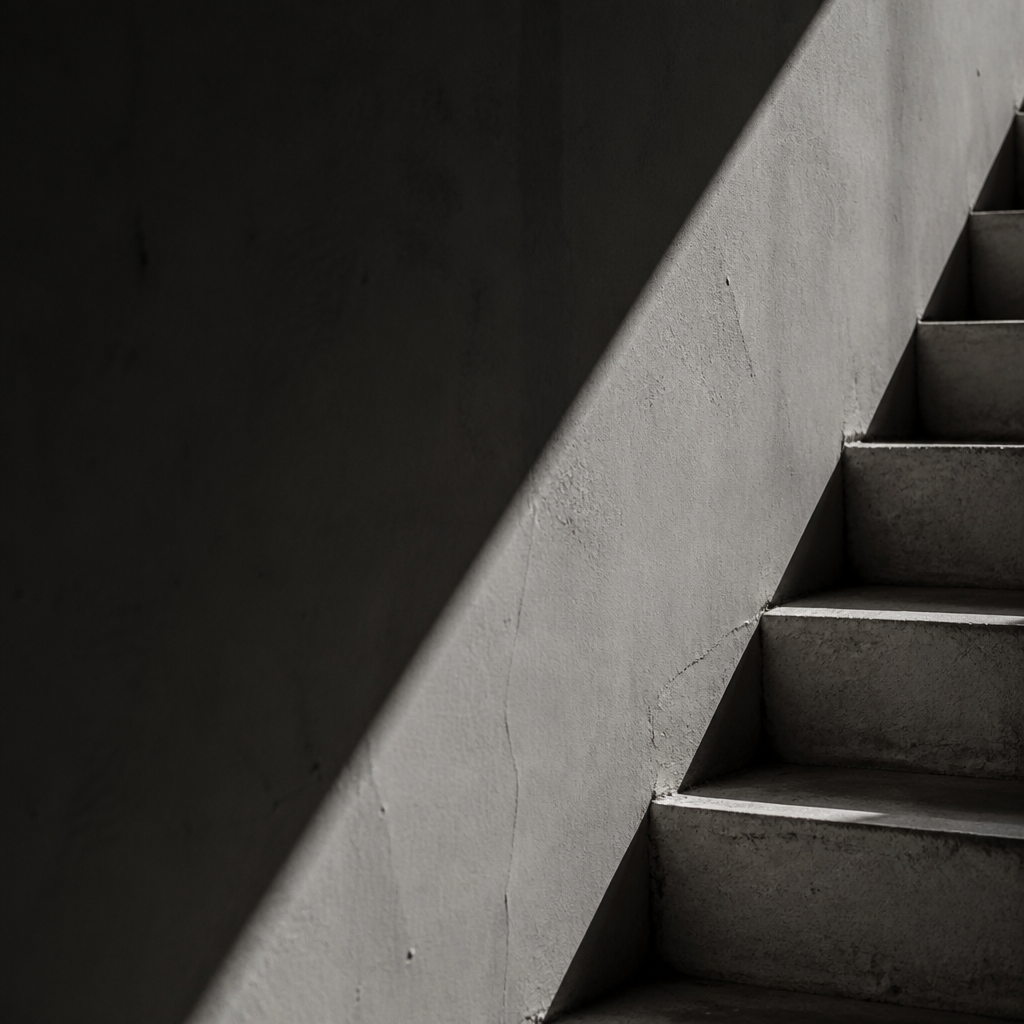
The clearest change between the two traditions is a practical one. German Expressionist sets often painted their distortion directly onto flat backdrops. Hollywood studios, working with more conventional set construction, achieved a comparable effect with actual lighting instruments, angled hard light sources, cutters and gobos, cast onto real walls, blinds and staircases.
| Technique | German Expressionist use | Noir adaptation |
|---|---|---|
| Distorted shadow | Painted directly onto flat set backdrops | Cast by real light through blinds, bars or stair rails |
| Skewed geometry | Sets built with crooked walls and angles | Simulated through camera angle and lens choice on standard sets |
| Isolated figures | Actors placed against sparse, exaggerated backgrounds | Actors placed in a single pool of light within a dark frame |
[04] Terms Used in This Chapter
![[04] Terms Used in This Chapter : The German Expressionist Roots of Noir Lighting](/images/04-terms-used-in-this-chapter-the-german-expressionist-roots-of-noir-l.jpg)
- German Expressionism
- A movement in 1920s German cinema built around visual distortion and heavy contrast, used to convey psychological unease.
- Émigré filmmaker
- A director, cinematographer or writer who relocated from Germany or Austria to the United States, mainly through the 1930s.
- Canted angle
- A shot framed with the camera deliberately tilted off the horizontal, used to unsettle the viewer. Also called a Dutch angle.
- Gobo
- A cut-out placed in front of a light source to cast a specific shadow pattern, such as the stripes of a venetian blind.
Lighting was only half of what noir inherited before it had a name. Chapter three follows the other root: the American crime fiction that gave the style its plots and its voice.